
Irvine Kitchen Hood Cleaning repairs commercial kitchen hoods in Irvine, CA and the surrounding cities including Tustin, Santa Ana, Orange, Costa Mesa and Garden Grove. We repair the hood itself — the canopy, plenum, filter rails, grease cups, lighting and access — as distinct from the fan on the roof, which is its own trade with its own failure modes.
Hood faults tend to be discovered during a cleaning rather than reported, because most of them are not dramatic enough to make anybody pick up a phone. A filter that no longer seats, a rail bent out of line, a grease cup that has been missing so long nobody remembers it: each is a small thing that quietly moves grease somewhere it should not be going.
That is the argument for having the crew that cleans your system also repair it. We are looking at the components with the filters out and the plenum open, which is the only position from which most of these faults are visible at all.
Filters, Rails and Capture
Baffle Filters and Correct Fit
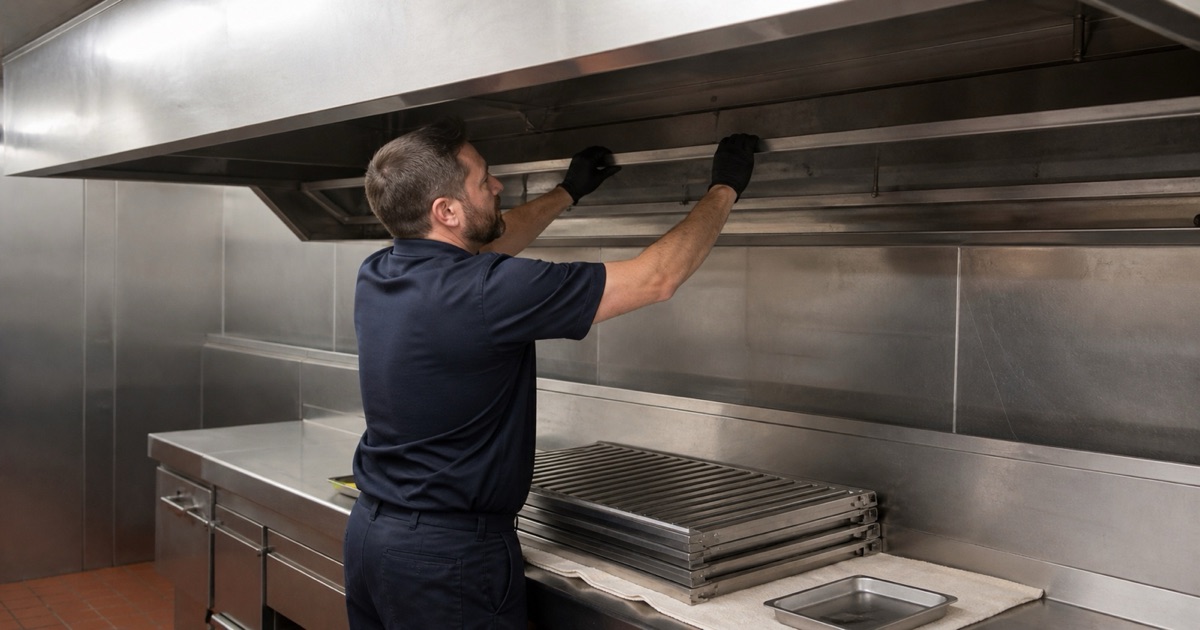
Baffle filters listed under UL 1046 only work when they sit properly in their rails at the correct angle, because the geometry is what separates and drains the grease. A filter that is the wrong size, bent, or slotted in loosely leaves gaps that let vapor straight past into the plenum. We size and supply replacements to the hood rather than to whatever fits, and we will tell you when a filter is simply worn out. A filter bank is only as good as its worst-fitting element, because vapor takes the easiest route through it every time.
Hanging Rails and Filter Retention
Rails and retention clips bend, corrode and get knocked out of alignment during cleaning, and a rail out of line stops the whole bank of filters seating as designed. The result is a permanent bypass that no amount of cleaning fixes. Straightening or replacing rails is inexpensive and it restores the capture the hood was designed to deliver rather than working around the loss.
Grease Cups, Troughs and Drainage
Filters drain into a cup or trough, and that path only functions if the cup is present, correctly positioned and actually emptied. A missing cup sends grease onto the cook line or into the hood body, and a blocked trough backs it up behind the filters. These are the cheapest components on the whole system and among the most consequential when they are absent. A missing cup is also one of the few faults a health inspector will spot from the customer side of the pass, which makes it worth fixing on sight.
Hood Body, Panels and Access
Damaged and Corroded Hood Sections
Dents, split seams and corroded sections in a hood body trap grease in places that cannot be cleaned properly, and a seam that has opened lets vapor into the cavity behind the hood entirely. We repair or replace affected sections rather than cleaning around them indefinitely. A hood that cannot be brought to bare metal because the metal itself has failed is a repair question rather than a cleaning question, and no number of return visits will change that. Reporting it honestly is cheaper for you than cleaning around it twice a year indefinitely.
Access Panels on the Hood and Duct
Where a plenum section or a duct collar cannot be reached, a listed access panel makes it serviceable permanently. This is the single most common repair that comes out of an exceptions report, and it converts a recurring “could not be cleaned” line into a section that gets cleaned like every other. Panels are installed with gaskets rated for the service rather than improvised.
Lighting and Fixtures in the Canopy
Hood lights take heat, steam and degreaser, and fixtures fail or fill with moisture. Beyond the obvious problem of a cook line nobody can see properly, a broken lens is a physical contamination risk over open food that a health inspector will treat seriously. We replace fixtures and lenses with units rated for the position rather than whatever happens to be on the shelf, since a fitting not built for the heat and the washdown will fail again inside a year and take another lens with it.
Suppression, Interfaces and What We Do Not Touch
Working Around the Wet Chemical System
A hood repair happens in the same space as the suppression nozzles, fusible links and piping, and none of those are ours to adjust. We work around them carefully, and we report what we saw — a nozzle out of position, a missing blow-off cap, a link that looks past its date. Servicing the system itself is a separate trade on its own semi-annual cycle under NFPA 17A.
Coordinating With the Suppression Contractor
Some hood repairs genuinely require the suppression contractor to be involved, particularly where nozzle position relates to the appliance line below or where a panel has to come off near piping. We will say so rather than working around a system we should not be disturbing. Title 19 also makes tampering with a required tag an offense, which is a good reason for clear boundaries.
Appliance Changes and Nozzle Coverage
When a kitchen swaps a fryer for a charbroiler or moves the line around, the suppression coverage designed for the old layout may no longer match the new one, and the hood may not either. We flag it when we see it. It is not our system to redesign, but a hood repair is exactly the moment somebody should be asking the question.
Repairs That Come Out of a Cleaning
The Exceptions Report as a Repair List
Every cleaning produces a written list of what could not be reached and why, and most of that list is a repair rather than a mystery. Quoted alongside the report, it becomes a plan with prices rather than a recurring complaint. This is how an older system gets brought back to fully cleanable over two or three visits instead of never.
Fixing It While the System Is Open
A repair carried out during a scheduled cleaning costs less than the same repair as its own visit, because the access, containment and disruption have already been paid for once. We quote them together for that reason. It also means the repaired section gets cleaned properly on the same night rather than waiting for the next cycle.
Knowing When to Stop Repairing
There is a point at which a hood body has corroded far enough that repair is no longer sensible, and we will say so rather than selling patches indefinitely. Replacement is a bigger conversation involving listings, make-up air balance and often the fire authority. Being told plainly where that line is beats discovering it during an inspection, and it lets you budget for a replacement in a quarter of your choosing rather than in the week a fire inspector picks for you.
- 20+ Years in Orange County
- Overnight & Between Services
- Photographed to Bare Metal