
Irvine Kitchen Hood Cleaning repairs commercial kitchen exhaust fans in Irvine, CA and the surrounding cities including Tustin, Lake Forest, Costa Mesa, Santa Ana and Newport Beach. Twenty years of taking these fans apart to clean underneath them means we usually recognize a failure by sound and by what the wheel looks like before any tool comes out of the truck.
A rooftop exhaust fan is the least visited component in a commercial kitchen and the one whose failure shuts the kitchen fastest. When it stops pulling, the hood stops capturing, smoke banks back over the line, and a health inspector or a fire inspector will take a view about whether you should be cooking at all. That makes diagnosis worth doing properly rather than quickly.
The most common outcome of a genuine diagnosis is that the fan does not need replacing. A wheel packed with grease is badly out of balance and sounds exactly like a motor on its way out, and it costs a fraction of a motor to put right. We check that first because it is the answer more often than it is not.
Diagnosing Before Quoting a Replacement
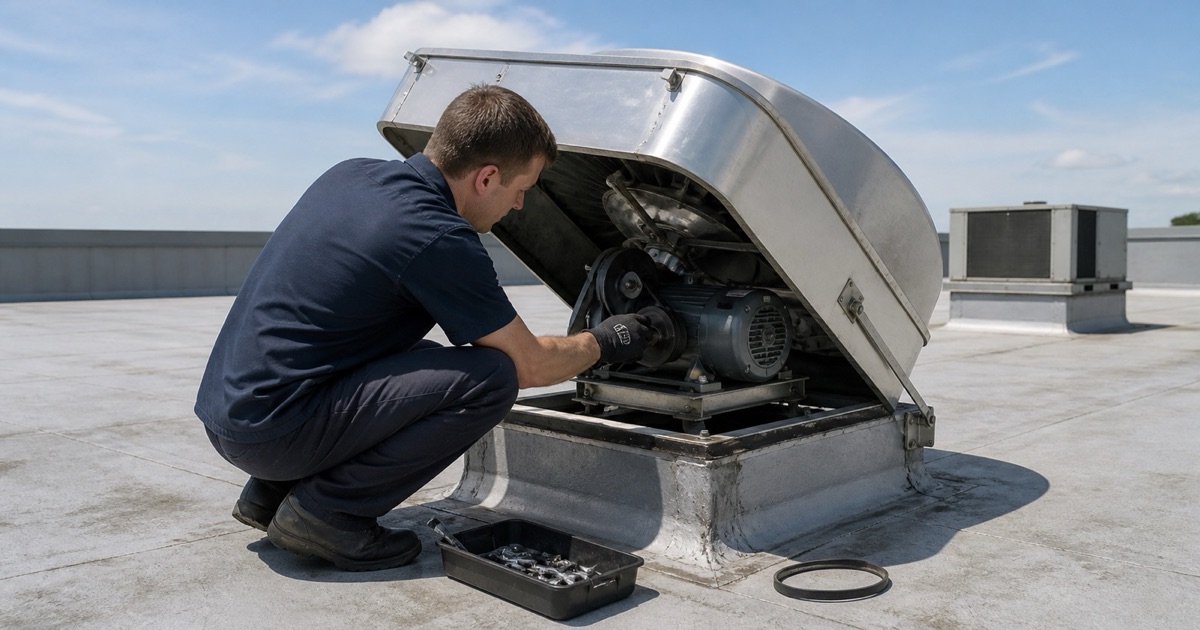
Belts, Bearings and Drives
A belt-driven upblast fan loses air through a slipping, glazed or broken belt long before anything dramatic happens, and the symptom is gradual enough that a kitchen adapts to it without noticing. Bearings announce themselves differently, with heat and a rising noise that changes pitch under load. Both are wear items with a service life, and both are inexpensive next to the assembly they sit in. We carry the common sizes rather than scheduling a second visit to fit a belt, because a fan that is down for a week over a five-dollar part is a scheduling failure rather than a mechanical one.
Motors and Electrical Faults
A motor that trips, hums without starting, or runs hot is a different problem from one that is simply working against a loaded wheel. Testing under load separates them, and it separates both from a supply or control fault that has nothing to do with the fan at all. Replacing a healthy motor because the fan was not moving air is the most expensive wrong answer available here, and it is a common one because it feels decisive.
Grease Load and Balance
A wheel carrying heavy deposits is out of balance by definition, and an unbalanced wheel vibrates, wears its bearings early, drops airflow and sounds terminal. Cleaning it frequently restores both the airflow and the noise profile completely. This is the reason we check the wheel before quoting anything: the fault and the routine cleaning are so often the same job, and a contractor who never lifts the fan cannot tell the difference.
Access, Hinges and Why Some Fans Cannot Be Serviced
Hinge Kits and Hold-Open Retainers
An upblast fan is meant to tilt back on a hinge kit so its housing, wheel and the curb underneath can be reached. A missing or seized hinge kit quietly converts every future cleaning into a partial one, because nobody is lifting a fan that has nothing to lift on. We install hinge kits and hold-open retainers where they are absent, which turns an uncleanable fan into a serviceable one permanently rather than for one visit.
Flexible Cable and Safe Lifting
A fan that tilts without a flexible weatherproof service cable drags on its own wiring every time it is opened, which is how an electrical fault gets built into a maintenance routine. The cable goes in alongside the hinge kit as a matter of course. It is a small part of the cost of the repair and it is the difference between a fan that can be opened safely for the next decade and one that cannot.
Curbs, Mounts and Weather Seal
The curb the fan sits on carries the load and keeps water out of the building, and a fan reseated carelessly after a repair leaks in the first serious rain. We check the mounting and the seal on the way back down rather than treating the repair as finished when the motor spins. Grease pooling around a curb also tells you something about containment that is worth acting on while the roof is open.
Repair Alongside the Cleaning
One Visit for Both
Because we are already lifting the fan to clean under it, most repairs happen inside a scheduled cleaning rather than as a separate rooftop mobilization. That removes a second call-out, a second access arrangement and a second night of disruption. It also means faults get found while they are still cheap, which is the entire argument for having the same crew do both.
What We Find Before It Fails
A belt going hard, a bearing beginning to run warm, a hold-open retainer that no longer holds, a containment pad saturated to the point of uselessness: none of these stop a kitchen today and all of them will. They go into the report with the cleaning, priced, so the decision is yours to make on a calm afternoon rather than at six on a Friday with a full book.
Emergency and After-Hours Response
When a fan does fail outright, the kitchen usually cannot trade, so response time is the whole service. We handle these overnight and after hours because that is when a restaurant discovers the problem and when it needs to be fixed. Diagnosis still comes first, even under pressure, because a fast wrong replacement costs more than a slow right repair.
Airflow Problems That Are Not the Fan
Make-Up Air and Negative Pressure
A kitchen starved of make-up air goes negative, and the symptoms look exactly like an exhaust failure: the hood stops capturing, smoke rolls out over the line and doors become hard to pull open. The exhaust fan may be in perfect health throughout. California requires make-up air at the rate exhausted, and checking the supply side before condemning the exhaust side is basic diagnosis rather than an upsell.
Loaded Filters and Restricted Duct
Saturated baffle filters and a heavily loaded duct run both restrict airflow, and both present at the hood as a fan that has weakened. A system that has gone too long between cleanings will show a measurable capture problem that a cleaning resolves completely. That is why airflow complaints are worth investigating with a cleaning history in hand rather than in isolation.
Backdraft, Weather and Discharge Obstruction
Wind conditions, an obstructed discharge, or a neighboring rooftop unit drawing from the wrong place can all disturb a system that is mechanically sound. These are diagnosed on the roof rather than from the kitchen, and they are the reason a fault that comes and goes is worth reporting with the conditions attached. An intermittent problem is still a problem, and it usually has a physical cause somebody can point at once the roof has been walked with the fault in mind rather than after it has cleared.
- 20+ Years in Orange County
- Overnight & Between Services
- Photographed to Bare Metal