Kitchen Hood Cleaning in Irvine, CA

Hood, plenum, duct, riser and rooftop fan cleaned to bare metal and photographed there — on the interval your cooking volume actually sets.

Irvine Kitchen Hood Cleaning has spent 20+ years cleaning commercial kitchen exhaust systems across Irvine and the wider Orange County market, from single-hood taquerias to hotel banquet kitchens and hospital cafeterias that never close. We clean the whole system — hood, filters, plenum, horizontal duct, vertical riser and the rooftop fan — and we photograph the bare metal we leave behind. Restaurant hood cleaning, exhaust fan repair, kitchen exhaust inspection and rooftop grease containment all come from one crew on one visit.

Most operators meet us because something forced the issue. A fire inspector left a correction notice, an insurance carrier asked for cleaning records nobody could produce, or grease started finding its way down an exterior wall onto a landlord’s roof membrane. Those are all the same underlying problem, and it is almost never the one the paperwork describes.

The thing worth knowing before you call anyone is that the California Fire Code sets an inspection interval, and cleaning is triggered by what that inspection finds. That is not the same as a cleaning schedule, and the difference decides how often you should actually be paying for this work. We explain the two separately, on every account, because the code treats them separately.

Get Your Free Quote

Fast response • No obligation

So we can reach you about your request.

So we can send you a confirmation after you submit this inquiry form.

  • 20+ Years in Orange County
  • Overnight & Between Services
  • Photographed to Bare Metal

What we do

Our Services

Commercial kitchen exhaust cleaning for Irvine and Orange County

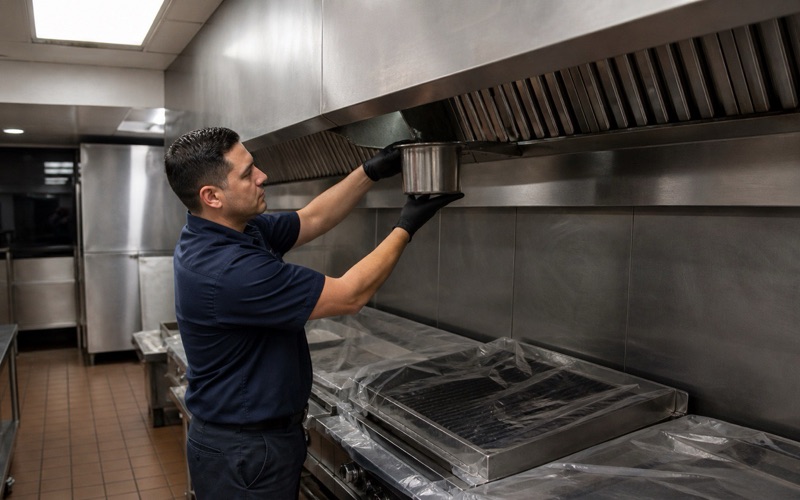
A technician drawing a grease cup from beneath the filter bank of a

Restaurant Hood Cleaning

Restaurant hood cleaning across Irvine and Orange County — cleaned to bare metal, photographed by area, scheduled around service.

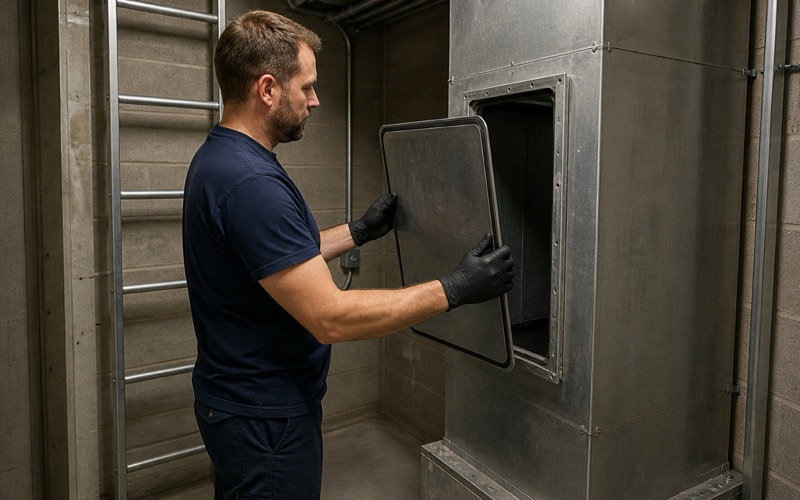
A worker easing an access panel away from a vertical grease duct riser

Commercial Kitchen Exhaust Cleaning

Commercial kitchen exhaust cleaning across Irvine and Orange County — full system, measured grease depth, records written for an inspector.

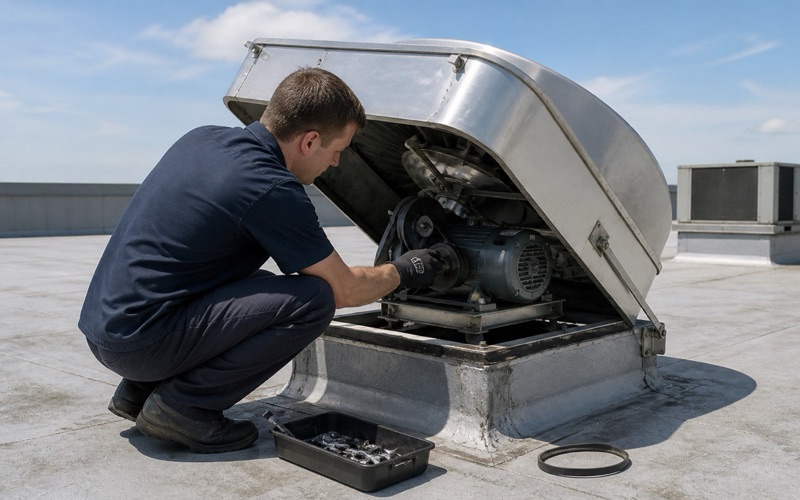
A technician fitting a replacement drive belt to a tilted rooftop

Exhaust Fan Repair

Rooftop kitchen exhaust fan repair across Irvine and Orange County — diagnosed before it is replaced, and cleaned while the fan is open.

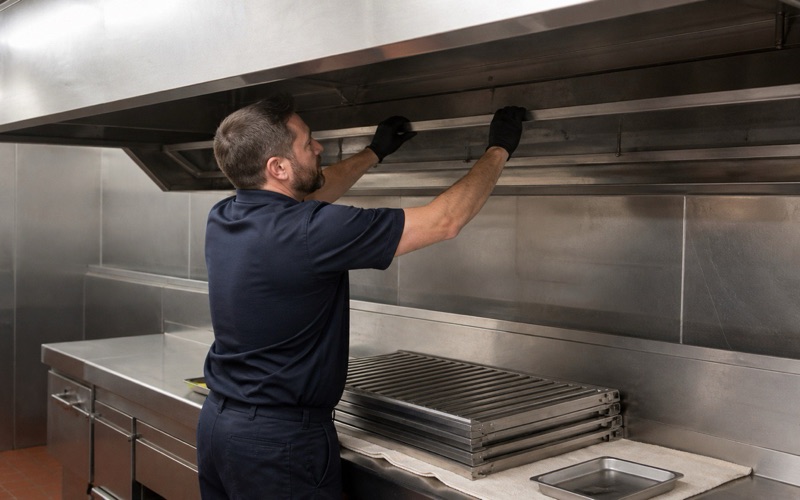
A worker straightening a bent filter rail inside a commercial hood with

Kitchen Hood Repair

Commercial kitchen hood repair across Irvine and Orange County — filters, rails, grease cups, panels and hood body, repaired by the crew that cleans it.

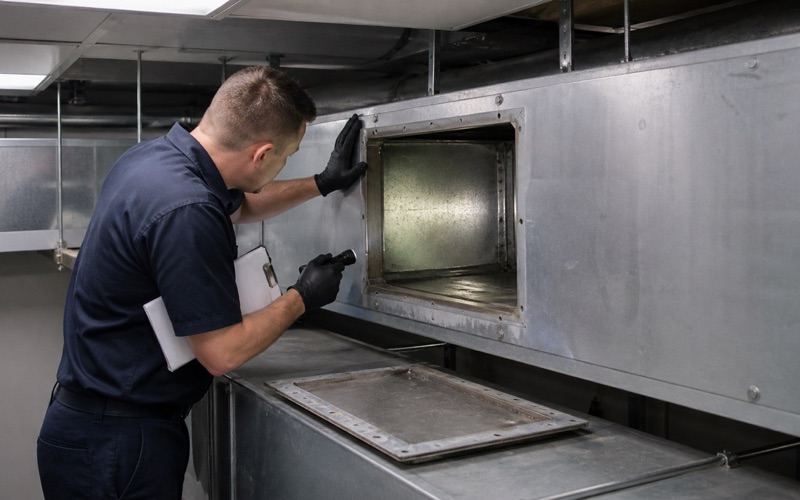
A technician examining the inside face of an open duct access panel

Kitchen Exhaust Inspection

Kitchen exhaust inspection across Irvine and Orange County — measured grease depth, a written record, and the interval your cooking volume actually sets.

A rooftop exhaust fan wheel with half its blades cleaned to bright

Exhaust Fan Cleaning

Rooftop exhaust fan cleaning across Irvine and Orange County — fan lifted, wheel and housing cleaned, curb and containment serviced.

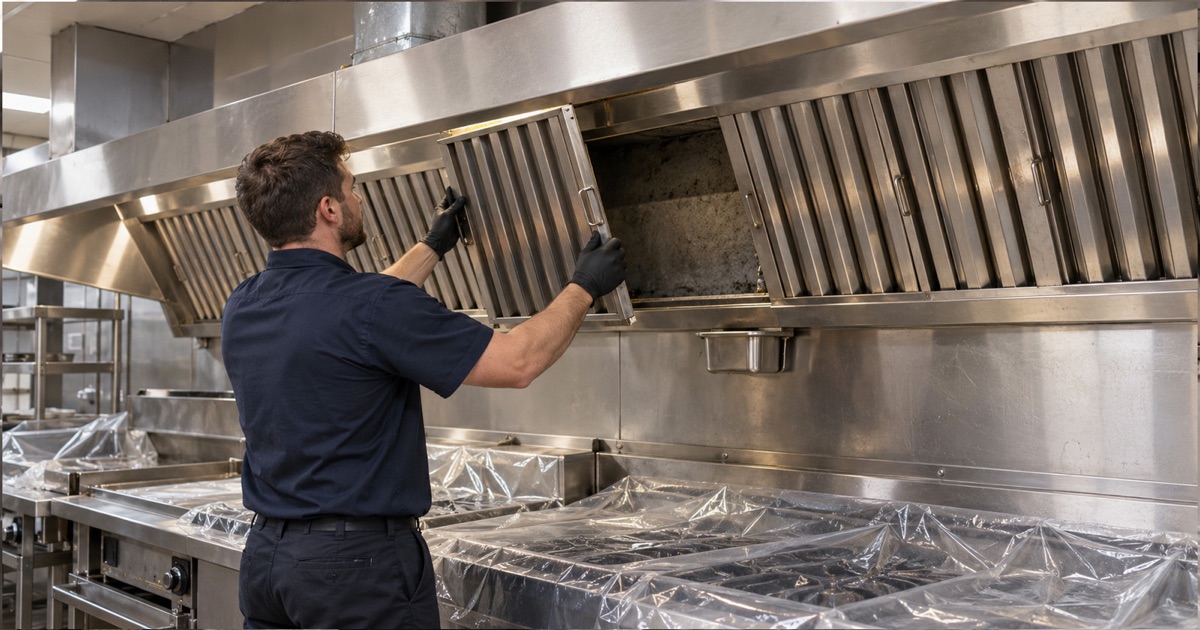
A worker sliding a clean baffle filter into its rail beside a bank of

Hood Filter Replacement

Commercial hood filter replacement and exchange across Irvine and Orange County — correctly sized baffle filters that actually seat in their rails.

A technician lifting a saturated absorbent pad from a rooftop grease

Rooftop Grease Containment

Rooftop grease containment across Irvine and Orange County — installed, serviced and photographed, because the membrane is the owner's exposure.

A worker offering a new listed access panel up to a cut opening in a

Grease Duct Access Panel Installation

Grease duct access panel installation across Irvine and Orange County — listed panels fitted so an unreachable run becomes cleanable for good.

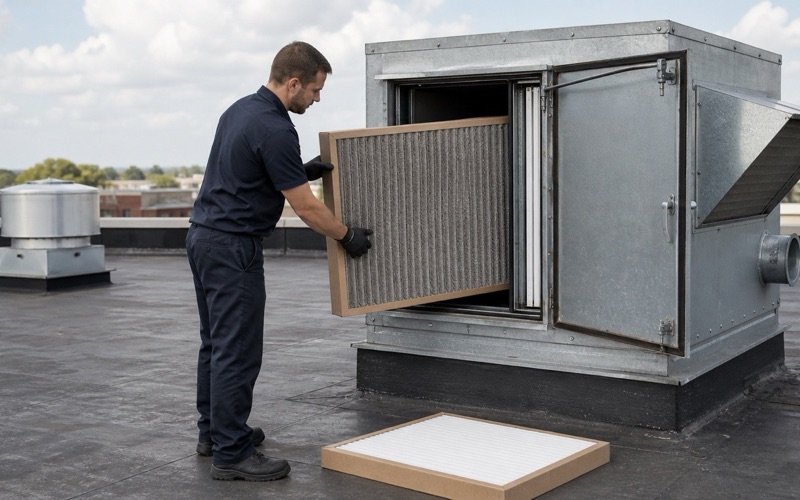
A technician sliding a filter out of an open rooftop make-up air unit.

Make-Up Air Unit Service

Make-up air unit service across Irvine and Orange County — the supply side of the kitchen, serviced by the crew that cleans the exhaust side.

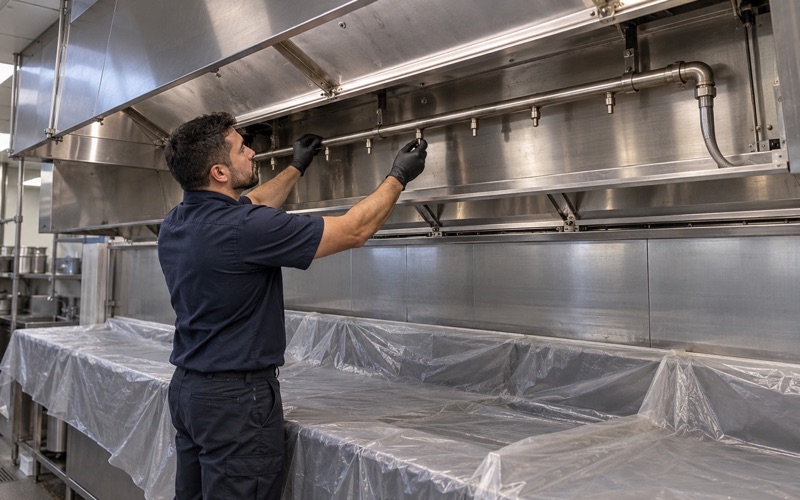
A worker checking the wash manifold and spray nozzles inside an open

Water-Wash Hood Cleaning

Water-wash and self-cleaning hood service across Irvine and Orange County — surfactant systems maintained, and everything downstream cleaned by hand.

Two Decades of Orange County Cook Lines

A technician lifting a baffle filter clear of its rail on a closed

20+ Years on Commercial Exhaust Systems

We have worked Orange County kitchens for more than twenty years, which in this market means wok lines on Bolsa Avenue, charbroilers and planchas in downtown Santa Ana, tabletop charcoal barbecue on Garden Grove Boulevard, and solid fuel in kitchens that never advertise it. Cooking type drives everything downstream, and it is the first thing we look at.

Why Choose Irvine Kitchen Hood Cleaning

Bare Metal, Photographed

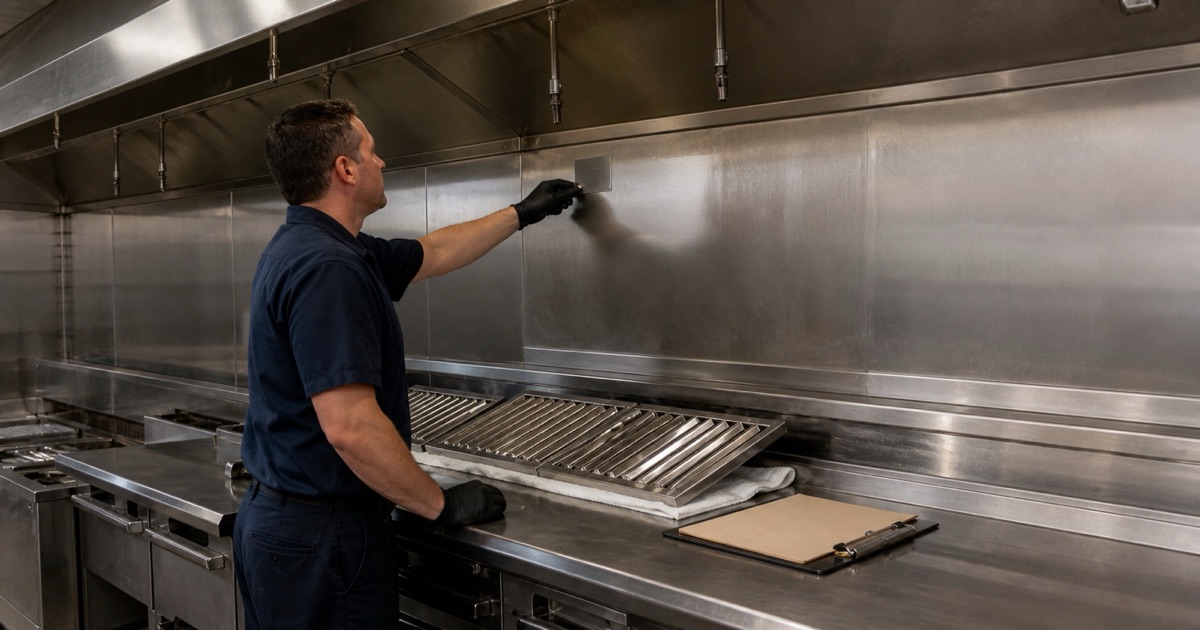
Every cleaning ends with photographs of bare metal taken at the surface itself, organized by area rather than as one flattering shot of the cleanest panel, so you can see what your money bought rather than take a checkmark on faith — rather than a sticker applied to a hood whose duct nobody opened.

The Interval Your Kitchen Actually Sets

No account gets a default six-month cycle. We band your kitchen by what it cooks, because the fire code frequency table separates solid fuel, high-volume operations such as 24-hour cooking, charbroiling and wok cooking, moderate volume, and low-volume kitchens, so a wood-fired pizza oven is not scheduled like a senior dining room.

Written Where We Could Not Reach

Anything we could not clean is named in writing with the reason it could not be reached, so an inaccessible duct run becomes an access panel quote instead of a silent gap — rather than a report that simply omits the section and reads as complete.

Built for the Orange County Patchwork

The fire authority is not the same across this service area. Orange County Fire Authority covers Irvine and twenty-two other member cities plus unincorporated county, while Anaheim, Orange, Fullerton, Newport Beach, Costa Mesa, Huntington Beach, Brea, Laguna Beach and Fountain Valley run their own departments, and we write your records to the authority that will actually read them.

Records That Survive an Audit

Every visit produces a service record we keep and reproduce on demand, because the request usually arrives from a fire inspector, an Orange County Health Care Agency inspector or an insurance carrier months after the work — rather than a paper tag that goes missing with the binder it lived in.

Cleaning the Whole System, Hood to Rooftop Fan

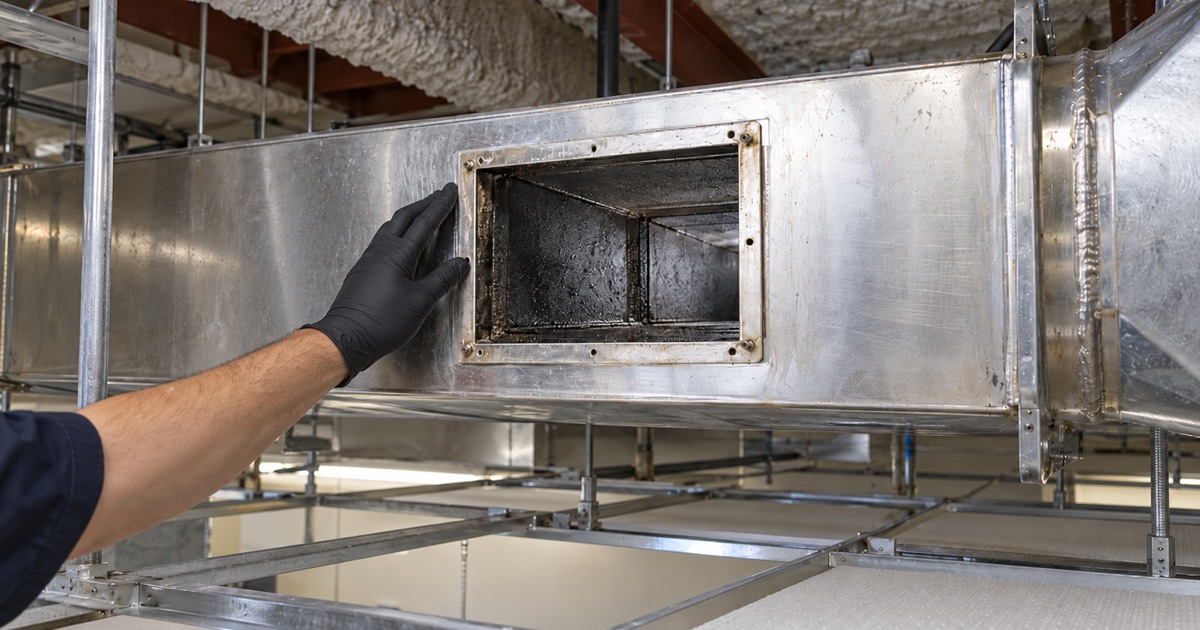
An open duct access panel on a horizontal grease duct run above a

What Hood-to-Fan Cleaning Actually Covers

A complete kitchen exhaust cleaning runs from the filters to the fan discharge: hood interior, baffle filters, plenum, horizontal duct, vertical riser and the rooftop unit. We price and perform all of it as one scope. Most quotes that look cheap have quietly stopped at the hood, which is the one section a customer can see.

Cleaning to Bare Metal, and How to Tell

Bare metal is the trade’s actual acceptance standard, not a marketing phrase — the surface should read as clean steel rather than a wiped-down film. We photograph it at the surface. Run a fingertip along a cleaned panel and there should be nothing to lift off it.

Hand Scraping Versus Pressure Washing

Hardened carbon deposits do not dissolve, so they come off with scrapers before any water moves. Pressure washing then carries the softened residue out. Using pressure alone on baked deposits polishes them, which looks better under a flashlight and leaves the fuel load exactly where it was.

The Plenum Behind the Filters

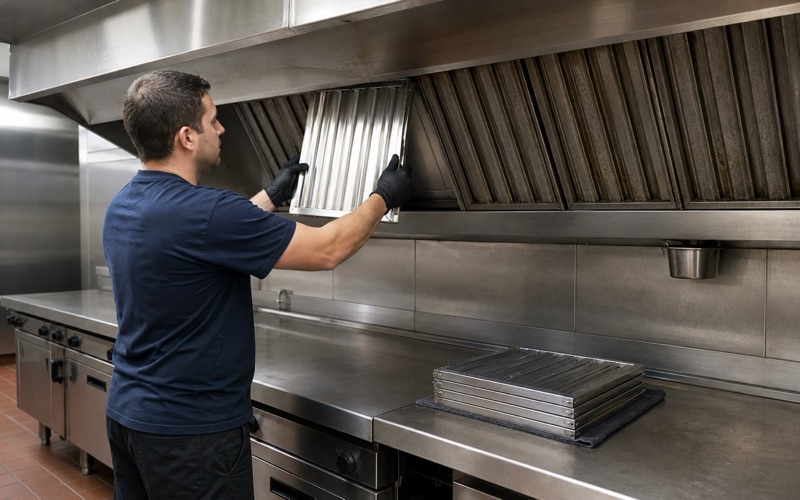
The plenum is the chamber behind the baffle filters where grease collects faster than anywhere else in the hood, because it is the first place vapor slows down. We pull filters and clean the plenum on every visit. It is also the section most often skipped, since replacing the filters hides it completely.

Horizontal Runs, Risers and What Nobody Sees

Duct runs above ceilings and risers inside shafts hold most of a system’s grease and none of its visibility. We open them at existing access points and clean the full length. A system judged by its hood is being judged on the small fraction of it anyone ever looks at.

The Upblast Fan and What Lives Under It

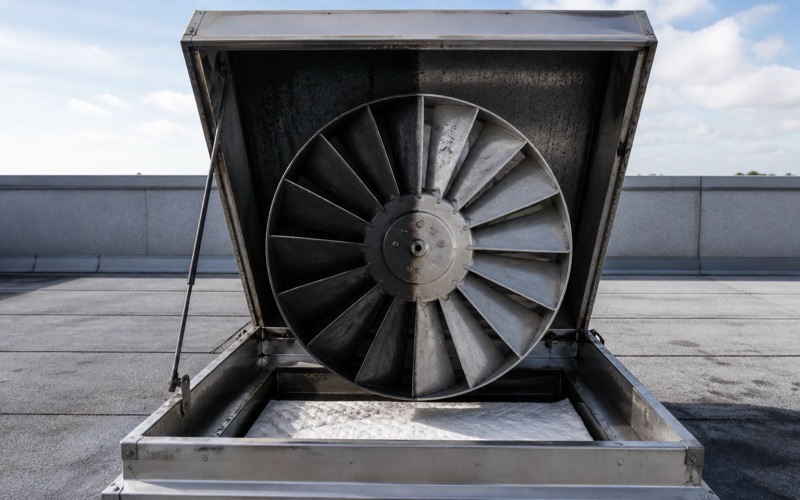
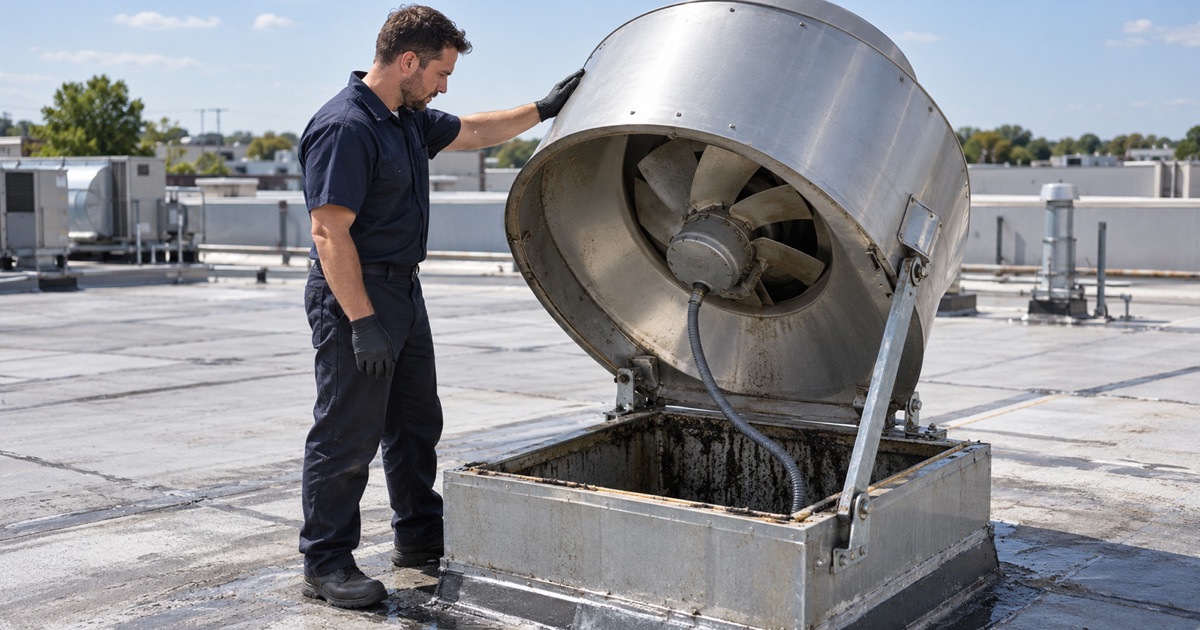
The rooftop upblast fan tilts back on a hinge kit so its housing, wheel and the curb beneath can be cleaned. Grease pools under a fan that has never been lifted. We clean the wheel, the housing interior and the curb, and set the fan back down on its hold-open retainer.

Grease Depth, Measured and Recorded

Depth is measured with a comb rather than described. NFPA 96 treats a measured depth of 2,000 micrometers — roughly 0.078 inch — as the point at which a system requires cleaning, and cleaning is performed to a maximum remaining depth of 50 micrometers, about 0.002 inch. We record the reading rather than calling a system dirty.

The Written Report of What We Could Not Clean

NFPA 96 expects areas that were not cleaned to be reported to the owner rather than left unmentioned. That report is the honest half of this trade, and it is where an access panel quote comes from. A report with no exceptions on a twenty-year-old system usually means nobody looked.

Before, During and After, Organized by Area

Photographs are taken in three stages and filed by area of the system, so the hood, plenum, duct and fan each carry their own evidence. One wide shot of a clean hood proves nothing about a riser. Inspectors and carriers ask for these far more often than operators expect.

Inspection Frequency, Code, and What Gets Enforced Here

A gloved hand holding a grease depth comb against the inside face of a

Inspection Interval Versus Cleaning Trigger

California Fire Code Table 606.3.3.1 is an inspection frequency table. Section 606.3.3.1 sets how often the system must be inspected, and Section 606.3.3.2 requires cleaning when that inspection finds contamination, in accordance with ANSI/IKECA C10. “The code requires quarterly cleaning” is the sentence almost everyone repeats, and it is not what the code says.

What Your Cooking Volume Sets

The bands are monthly for solid fuel cooking, quarterly for high-volume operations, semi-annually for moderate volume, and annually for low-volume kitchens such as churches, seasonal businesses and senior centers. Your band is a function of what comes off the line, not of what a service company finds convenient to schedule.

Solid Fuel in a Band of Its Own

Wood and charcoal cooking sit in the shortest interval because they deposit creosote as well as grease, and they frequently require their own dedicated exhaust system. A wood-fired oven or a charcoal grill changes the whole compliance picture for a kitchen. It is also the detail most often left off an inquiry.

Wok Cooking as a Frequency Escalator

Orange County Fire Authority Guideline D-02 names wok cooking alongside 24-hour cooking and charbroiling in its high-volume band, and OCFA’s public guidance separately names stir frying and wood or charcoal use as reasons to clean more often. In Little Saigon and along Garden Grove Boulevard that is not a detail, it is the schedule.

Orange County Fire Authority, and Where It Stops

OCFA is the fire authority for Irvine, for twenty-two other member cities and for unincorporated Orange County. It is not the authority everywhere we work. Several cities in this service area run their own fire departments with their own submittal requirements, and one of them permits every Type I hood suppression system individually.

Two Inspectors, Two Sets of Questions

The fire inspector is looking at the exhaust system, the suppression system and your service tag. The environmental health inspector is looking at ventilation adequacy under the California Retail Food Code, cleanliness of surfaces and whether the kitchen can hold temperature. Both can write you up over a hood, for different reasons.

The Service Tag and Why Old Ones Come Off

The California Fire Code requires a tag recording who cleaned the system, when, and what was not cleaned, and it requires prior tags to be covered or removed so the current one is unambiguous. Title 19 of the California Code of Regulations separately makes removing or defacing a required tag an offense, which is why we handle them rather than the kitchen.

Records, Retention and Producing Them

Cleaning records are worth exactly as much as your ability to produce them on the day somebody asks. We keep every report and reissue it on request. The requests that matter almost always come after a claim, a change of ownership or a failed inspection, when reconstructing the history is no longer possible.

Correction Notices and Re-Inspection

A correction notice names a deficiency and a date. Clearing it usually means a documented cleaning and a re-inspection, and re-inspections are billable time in most jurisdictions. We schedule against the notice date rather than the next open slot, because the second visit costs more than the first.

Repairs, Access and the Parts That Fail

A rooftop upblast exhaust fan tilted back on its hinge kit and resting

Exhaust Fan Not Pulling

A fan that has stopped moving air is usually a slipping or broken belt, a seized bearing, a failing motor or a wheel so loaded with grease it is out of balance. We diagnose before quoting a replacement. A wheel packed with grease reads as a dying motor and costs a fraction of one to fix.

Hinge Kits and Hold-Open Retainers

A rooftop fan that will not tilt back cannot be cleaned underneath, so a missing or seized hinge kit quietly converts a full cleaning into a partial one. We install hinge kits and hold-open retainers where they are absent. Flexible weatherproof cable goes in with them so the fan can lift without stressing its wiring.

Access Panels Where a Run Cannot Be Reached

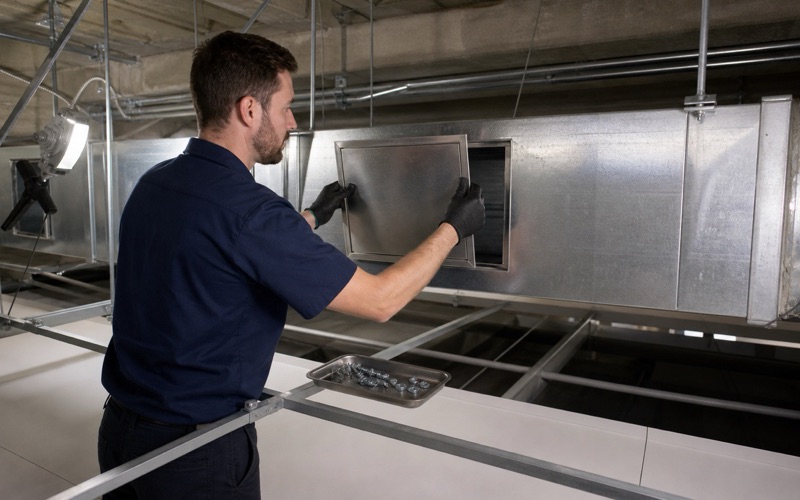
Where a duct run has no opening, it cannot be cleaned and it goes on the exception report. The fix is a listed access panel installed at the right interval along the run. We quote the panels rather than leaving a permanent gap in your records and your fire protection.

Baffle Filters Versus Mesh

Baffle filters are listed for grease duct service under UL 1046 and drain captured grease back to a cup by design. Mesh filters clog, saturate and drip onto the cook line, and they are prohibited in many jurisdictions for exactly that reason. The difference shows up on the floor before it shows up on an inspection.

Filter Exchange Versus the Sink

Washing baffle filters in a three-compartment sink ties up staff, floods the sink with grease and rarely gets them properly clean. An exchange program swaps them for cleaned filters on a set cycle instead. It also keeps grease out of the drain line and away from your interceptor.

Rooftop Containment and the Membrane Beneath

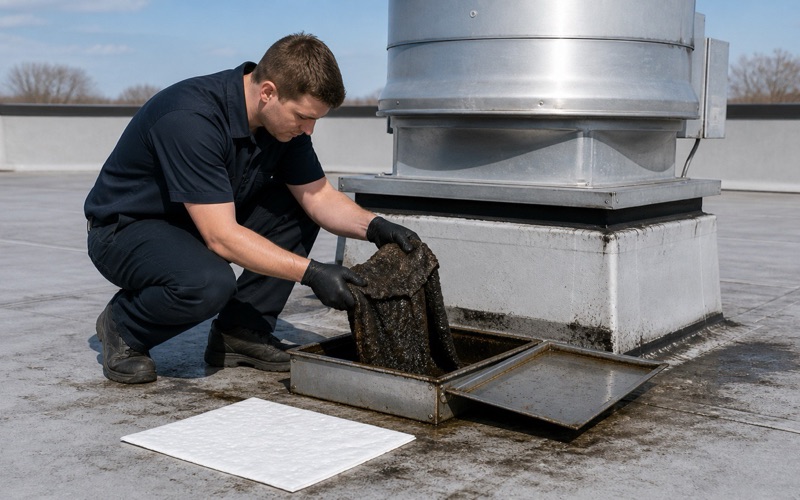
Grease containment boxes and absorbent pads sit under the fan discharge to catch what the system throws out. We check and service them on every visit. The pads are consumable, and a saturated pad is doing nothing except making it look like something is being managed.

Grease on the Roof, and Who Carries It

Grease degrades single-ply roof membranes and voids roofing warranties, and the exposure usually lands on the building owner rather than the tenant who cooked. That makes rooftop containment a landlord conversation as much as a restaurant one. We document roof condition around the fan so the question can be settled with photographs.

Make-Up Air, and the Door That Will Not Open

Make-up air replaces what the exhaust fan removes. When it fails, the kitchen goes negative: doors get hard to pull, the hood stops capturing, and smoke rolls out of a system whose fan is working perfectly. California requires make-up air at the rate exhausted, and we service the units and their filters.

Water-Wash and Self-Cleaning Hoods

Self-cleaning and water-wash hoods run a detergent cycle over the plenum, and they still need service — surfactant tank refills, pump and solenoid checks, wash-nozzle descaling and manual cleaning of everything downstream of the hood. Their ductwork and fans are not self-cleaning. Pollution control units, ultraviolet lamps and electrostatic precipitator cells carry their own maintenance intervals on top.

The Kitchens We Clean and What Changes the Schedule

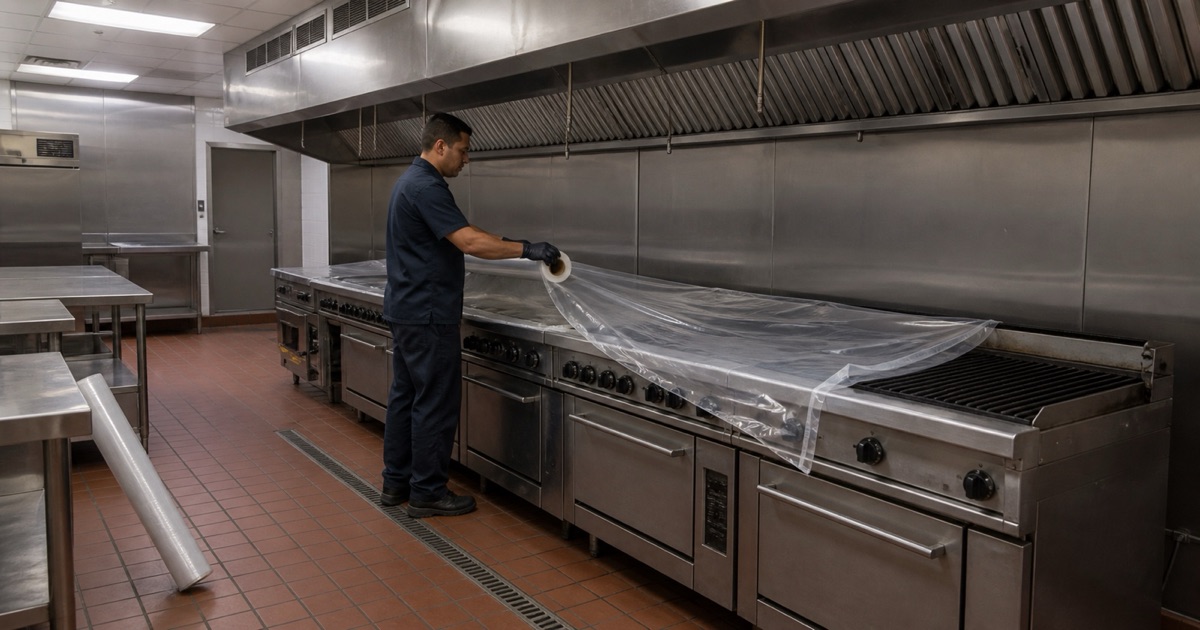
A worker laying containment sheeting over a closed commercial cook line

Full-Service Restaurants and the Cook Line

A full-service line with a charbroiler, fryers and a flat top produces the grease load the frequency bands were written around. We band the account on the equipment that actually runs, not the menu. One charbroiler used every service moves a kitchen further than a long list of items that rarely leave the walk-in.

Quick-Service Kitchens and Short Windows

Quick-service kitchens run long hours and close briefly, which compresses the cleaning window rather than the scope. We work overnight and between services so the kitchen never loses a cover. Fryer-heavy quick-service operations also load a system faster than their footprint suggests.

Hotel and Banquet Kitchens That Run in Bursts

Banquet kitchens sit idle and then cook for hundreds at once, so an averaged schedule misrepresents them in both directions. We schedule against the event calendar. A room that has done four banquets in a fortnight is not on the same footing as one that has done none.

Senior Living and Continuing-Care Dining

Continuing-care communities run multiple dining rooms under one owner, often with a contracted food service operator, and their residents cannot skip a meal while a kitchen is down. We stage work room by room. Gated communities also require contractor clearance before a truck reaches the loading area.

Hospital and Medical Center Food Service

Hospital kitchens run continuously against a fixed tray-service schedule, so there is no closing time to work behind. We negotiate the window around meal service rather than around our own routing. Cafeterias that stay open twenty-four hours need the work sequenced in sections instead of all at once.

School District and University Dining

District central kitchens and university dining halls cook at volume on an academic calendar, which makes breaks the obvious service window. We schedule around terms. High-volume production kitchens also tend to have longer duct runs than their hood count implies, because the cooking is concentrated and the discharge is remote.

Corporate Campus and Business-Park Cafeterias

Campus cafeterias peak on weekdays and go quiet, and they are usually bought through facilities management rather than by a chef. That changes what the buyer wants: documentation, a vendor-compliance file and a predictable interval. We write records to suit an audit rather than a kitchen noticeboard.

Shopping Center Tenants and Food Halls

Food halls put many small kitchens inside one building envelope, sometimes with duct runs climbing several floors to a shared roof. Center management is often the real decision-maker. We coordinate across tenants so the work happens once rather than as a dozen uncoordinated visits.

Ghost Kitchens and Commissaries

A commissary shell can hold several tenants sharing infrastructure, and each one still carries its own obligation for the system serving it. We document by tenant and by system so responsibility is legible later. Shared duct penetrations are where those arrangements usually turn out to be undefined.

Areas We Serve

Irvine Kitchen Hood Cleaning provides kitchen hood cleaning throughout the greater Irvine area, with the same crews and the same standards on every job.

Good to know

Frequently Asked Questions

How often does a commercial kitchen exhaust system need cleaning in Irvine?

That depends on what you cook. The California Fire Code sets an inspection interval by cooking volume — monthly for solid fuel, quarterly for high-volume operations such as 24-hour cooking, charbroiling and wok cooking, semi-annually for moderate volume, and annually for low-volume kitchens. Cleaning is then triggered by what the inspection finds, so the interval and the cleaning are two separate things.

Does the fire code actually require quarterly cleaning?

No, and this is the most common misunderstanding in the trade. California Fire Code Table 606.3.3.1 is an inspection frequency table. Section 606.3.3.2 requires cleaning when an inspection finds contamination, performed in accordance with ANSI/IKECA C10. A quarterly inspection obligation is not the same as a quarterly cleaning bill.

What does cleaning to bare metal mean?

It means the accessible surfaces of the hood, plenum, duct and fan are cleaned back to the metal rather than wiped down. NFPA 96 treats cleaning as complete when the remaining deposit is down to about 50 micrometers, roughly 0.002 inch. We photograph the surface so bare metal is something you can verify rather than something you are told.

Who is the fire authority for my kitchen?

It depends on the city. Orange County Fire Authority covers Irvine, twenty-two other member cities and unincorporated Orange County. Anaheim, Orange, Fullerton, Newport Beach, Costa Mesa, Huntington Beach, Brea, Laguna Beach, Fountain Valley and Santa Fe Springs run their own departments, and their submittal and permit requirements differ. We write your records to the authority that will read them.

What happens if part of my duct cannot be reached?

It goes on the report, in writing, with the reason. NFPA 96 expects areas that were not cleaned to be reported to the owner rather than quietly omitted. In most cases the fix is a listed access panel installed on the run, which we quote separately so the gap closes permanently instead of reappearing on every future report.

Do you work overnight so we do not have to close?

Yes. Most of our work is done overnight or between services, because a commercial kitchen cannot give up a cover to a cleaning. We agree the window in advance and sequence the work so equipment is back in service before your first prep shift arrives.

Do restaurants in Orange County get a letter grade?

No. Orange County Health Care Agency posts an inspection notification seal reading PASS, REINSPECTION DUE or CLOSED rather than an A, B or C card. Letter grading was considered and not adopted here. Some of the Los Angeles County cities we serve do post letter grades, which is a genuine difference between two halves of one service area.

What is on the service tag, and can I remove an old one?

The tag records who cleaned the system, when it was done and what was not cleaned, and the code requires prior tags to be covered or removed so the current one is unambiguous. Title 19 of the California Code of Regulations makes removing or defacing a required tag an offense, so tags are something we manage rather than kitchen staff.

Does grease on the roof matter if the kitchen is fine?

It matters to whoever owns the building. Grease degrades single-ply roof membranes and commonly voids roofing warranties, and that exposure usually sits with the landlord rather than the tenant. Rooftop containment boxes and absorbent pads are checked on every visit, and we photograph the roof around the fan so the condition is documented.

Do self-cleaning and water-wash hoods still need servicing?

Yes. The wash cycle handles the plenum, but the ductwork, riser and fan downstream of it are not self-cleaning and still require manual work. The wash system itself needs surfactant refills, pump and solenoid checks and nozzle descaling. Pollution control units, ultraviolet lamps and electrostatic precipitator cells carry separate maintenance intervals of their own.

Ready to Get Started?

Request a free quote today and we'll get back to you fast.